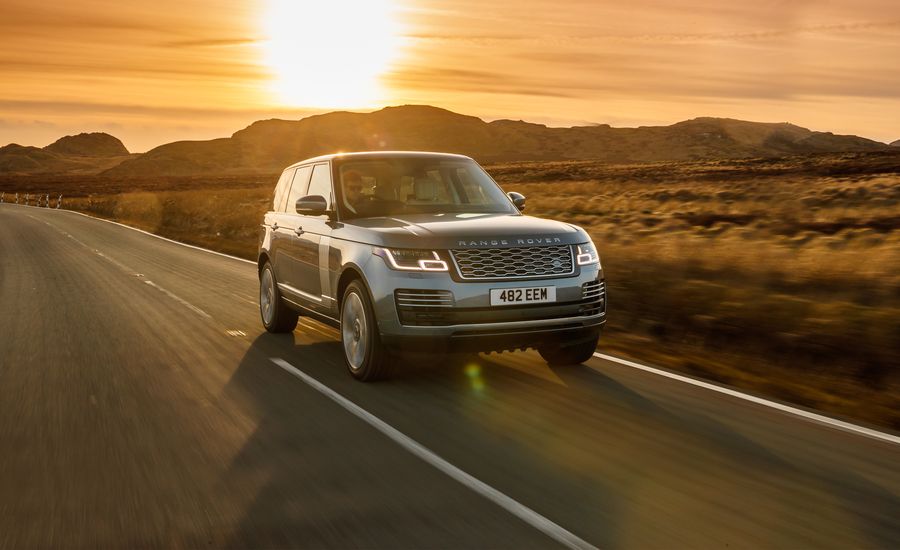
Until recently, the Range Rover stood as a seemingly impermeable bulwark against the very concept of downsizing. The physical scale of Land Rover’s flagship luxury SUV was imposing enough, but this was also matched by powerplants that clearly equated bigger with better, intended for an ownership demographic with little concern about fuel costs. Sure, there have been diesel versions for some time, initially for European skinflints and also now in America, but the first full-size, gasoline Range Rover to use anything other than a V-8 appeared fairly recently, in 2012.

Yes, there are switchable modes. The P400e can be coaxed into EV operation through a button on the center console, with pure-electric operation possible at speeds of up to 85 mph, although anything other than gentle pressure on the accelerator pedal will kick the internal-combustion engine back to life. There also is a Save mode, which holds onto existing battery charge for later use, but it’s accessed through a submenu of a submenu in the infotainment system and is not easy to find. If a destination is programmed into the navigation system then—as with systems from rivals such as Mercedes-Benz—the P400e will attempt to use the available charge as intelligently as possible.
Wade in the Water, Waft Down the Way
Impressively, the P400e will still go as far off-road as almost any other Range Rover. Our drive route included a chance to experience both the battery compartment’s waterproofing and the car’s claimed 35.4-inch wading capability—with the air-spring suspension in its raised position—by driving through a shallow lake. As the electric motor sits between the conventional engine and the transmission, its effort is sent through the eight-speed ZF automatic and on to all four corners through the same array of electronic and mechanical traction-boosting aids as its nonhybrid sisters. At very low speeds, the electric motor’s instant torque allows for finer control than with a conventional engine; this is the model to pick for rock-scrambling.
On the highway, the pillowy air springs continue to impress, although the P400e’s considerable mass becomes more evident as velocity rises. Ride quality is outstanding at urban paces, even over broken surfaces and in a car that rides on 21-inch wheels. But moderate cornering loads create noticeable body lean, and the ultimate grip limits are predictably modest, as the soft springs struggle to maintain discipline at higher speeds. The steering is accurate behind light assistance, and the Range Rover remains an easy car to place even on narrow English lanes thanks to the excellent visibility given by the pedestal-like driving position, but it is definitely happiest at a stately pace. Regenerative braking is less aggressive than in many hybrids and EVs—partially because it’s much heavier—and blends cleanly with the hydraulically operated friction brakes at lower speeds.

Comments
Post a Comment